A payment strategy for Argentina's iGaming market starts with understanding how players already manage money. What feels normal to them, and where does friction tend to interrupt a deposit or withdrawal? Argentina's financial system runs on instant transfers, virtual accounts and interoperable QR payments. Those are the habits any strategy has to work around.
Doing that means treating payment method selection, checkout design, transaction routing, risk controls, payout operations and performance monitoring as one system. A long menu means little if the methods players actually use don't work consistently.
Start with the way local players move money
According to the Central Bank of Argentina's 2025 Retail Payments Report, Argentina's payment market has become increasingly account-based: electronic fund transfers made up 65.6% of all transactions nationally, immediate push transfers rose 25.6% year on year, more than 61% of them tied to a virtual account identified through a CVU, and interoperable transfer payments grew 40.7%.
That shapes what players expect from a cashier. They have no patience for a deposit sitting pending with no explanation, and no tolerance for an ambiguous status when their banking app already shows where their money is.
A few practical questions follow:
- Which financial applications and account types do local players use regularly: banks, virtual accounts, cards, wallets?
- How quickly, and with what information, do they expect a payment to be confirmed?
- How do they respond when a payment fails?
Our guide to iGaming payment methods in Argentina covers which methods matter most. The strategy comes from understanding how they're actually used.
Prioritise relevance over payment method quantity
A common market-entry mistake is adding as many payment options as possible. More methods can look like more conversions. In practice, though, extra options often just make the cashier harder to navigate without improving performance.
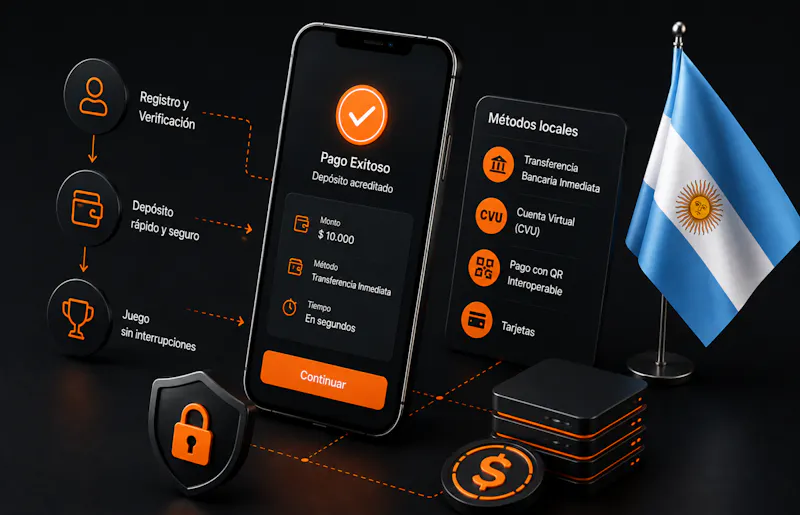
Most players stick to a small group of familiar products: usually digital wallets, instant transfers and established cards in Argentina.
A stronger approach is to prioritise methods according to:
- local familiarity
- expected player demand
- mobile usability
- transaction confirmation speed
- provider stability and withdrawal support
Coverage should also vary by segment: a mobile-first player depositing small amounts often needs different methods than a higher-value customer depositing less often.
The payment page shouldn't be a static catalogue. Positioning, naming and availability should all reflect actual player behavior.
Design the cashier around familiar local journeys
Even a recognised payment method can perform poorly when the integration feels unfamiliar. Players need to identify it quickly, understand what happens next, and get a clear result once it's done.
It matters most in mobile payment journeys, where every extra screen or unexplained redirect gives the player another reason to abandon the deposit.
A localised cashier should provide:
- familiar, Spanish-language method names and instructions
- transparent minimum and maximum amounts, with fees shown accurately where they apply
- clear confirmation whether the payment succeeds or fails
- a simple route back into the payment flow
The same logic applies to transaction-status language. A status like "pending" should say whether the payment is still processing, needs action, or has gone for review. A generic status with no context just drives up support and erodes trust.
Treat deposits and withdrawals as one system
Many operators focus most of their effort on the deposit experience, which makes sense during acquisition but leaves the strategy incomplete. A slow, unpredictable withdrawal after a smooth deposit can undo that trust fast, especially in a market used to immediate transfers between apps.
The payment team should determine:
- which local methods support withdrawals, and whether they must follow the original deposit route
- which payouts require manual approval
- what information is needed before releasing a withdrawal
- how the player is informed about the expected completion time
Moving checks earlier, or automating them, speeds up payouts. Cutting controls doesn't. It just shifts risk elsewhere, while legitimate withdrawals keep waiting on work that belonged at registration or deposit.
Build compliance into the payment journey
Argentina has no unified nationwide gambling licence. Oversight sits at the provincial and local level, so requirements depend on the jurisdiction.
National anti-money laundering rules apply too. UIF Resolution 194/2023 covers land-based and online gambling, with emphasis on risk assessment, customer due diligence, transaction monitoring and reporting suspicious activity.
The payment strategy, in other words, can't be separated from the operator's licensing and compliance model. Before choosing a provider or configuring transaction flows, operators need clarity on:
- which legal entity and jurisdiction the payment setup operates under
- what customer data must be collected
- when enhanced checks are required
- how deposits and withdrawals are linked to a verified player
Compliance controls work best when they scale with risk. Review every payment the same way, and low-risk players face friction while teams waste time on activity that never needed attention. Go too light, and fraud, account misuse and regulatory exposure climb instead.
Plan for provider and route instability
A payment method is only as reliable as the route supporting it.
Integrating a well-known local method doesn't guarantee consistent processing. Approval rates shift by provider, transaction type, player profile and time of day. Plan for what happens when the primary route underperforms, including:
- more than one provider for critical payment methods
- rule-based transaction routing
- real-time visibility into provider responses
- a recovery process that does not require the player to start again
Extra providers only help if the operator can see where transactions are failing and adjust routing quickly. Otherwise, they just add complexity.
A modern iGaming payment gateway is the control layer between the cashier, payment providers, financial institutions and the operator's internal risk systems, as important for routing and monitoring transactions as for processing them.
Use payment data to refine the strategy
The payment setup will rarely remain optimal as the operator grows. Player acquisition channels change, providers update their risk policies, and some methods gain adoption while others decline.
Operators need reporting that connects payment outcomes to player behaviour and operational performance. Useful metrics include:
- payment method selection rate
- successful deposit rate
- decline rate by method and provider
- time to payment confirmation
- checkout abandonment rate
- successful payout rate and average completion time
- payment-related support contacts
These metrics work together. A high selection rate with low completion suggests players recognise the method but struggle with the integration, and a high approval rate can still hide slow confirmation. Taken alone, any one can mislead.
Balance fraud controls with player experience
iGaming payments need stronger controls than ordinary retail transactions. Operators have to catch account takeovers, identity misuse, suspicious deposit patterns and money moving through gambling accounts, without controls turning so aggressive that legitimate players get blocked too.
The right balance comes from combining several signals at once. Mismatched account details, payment ownership, device behaviour and prior activity might flag a transaction. The same amount from a verified, familiar-device returning player carries far less risk.
Our guide to secure payments in iGaming covers how payment security, fraud monitoring, KYC and AML need to work inside the same operating environment, protecting the system without making normal activity feel suspicious by default.
Build for continuous adjustment
A payment strategy for Argentina isn't a one-time project. The local payment market keeps evolving. BCRA data shows strong, continued growth in immediate transfers and interoperable payments: in December 2025 alone, interoperable transfer payments hit roughly 96.4 million transactions, up 44% year on year.
Operators need to respond as player preferences, payment products and provider performance shift, with clear ownership of payment performance, regular provider reviews, and enough room to adjust transaction flows without redesigning the cashier.
The strongest payment strategies are built around a cycle:
- understand local player behavior
- select relevant payment methods
- design familiar payment journeys
- apply risk-based controls
- monitor transaction performance
- adjust routing and method availability
Turning payment knowledge into performance
Payments are part of the product experience itself for players in Argentina.
Players expect the same speed, clarity and control from the cashier that they already get from banking apps and digital wallets. Deliver that, and operators convert more deposits, field fewer avoidable support contacts and keep more trust.
The practical advantage comes from selecting the right methods, integrating them properly and building the infrastructure to keep them performing well. Offering every payment method available doesn't achieve any of that on its own.
For operators entering Argentina, local payment knowledge is the starting point. The long-term result depends on how well that knowledge gets translated into routing, risk management, payout operations and continuous optimisation.