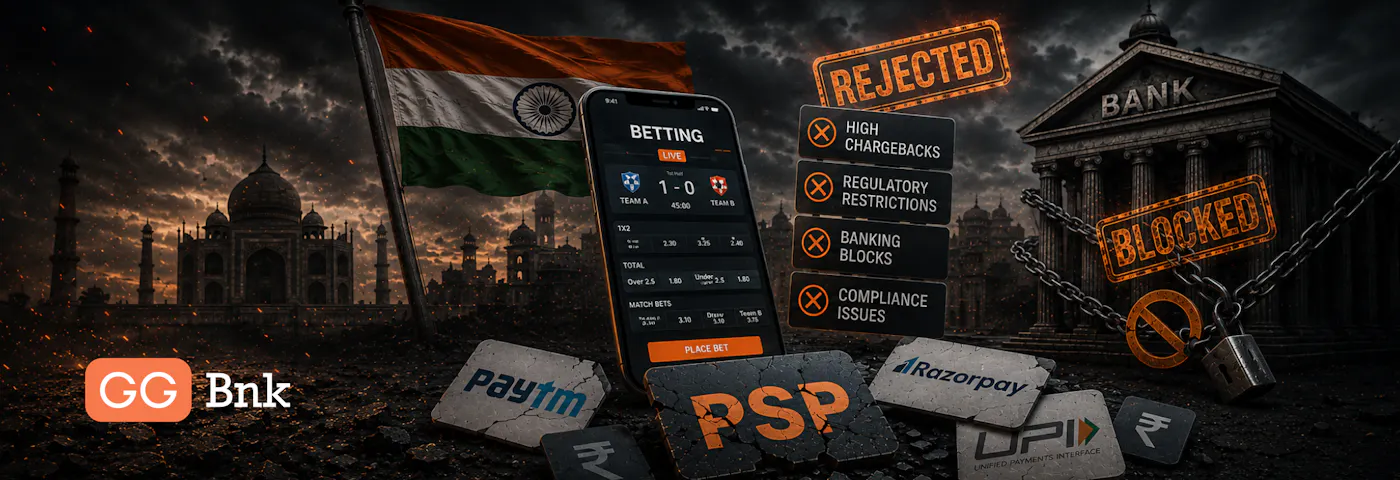
India looks attractive to every betting operator until payments start to break down.
At first, the market seems straightforward. Users know how to pay online. UPI adoption is massive. Deposits can happen in seconds. Local PSPs often promise coverage, speed, and scale.
Then volume starts growing.
One provider loses routing capacity. Another slows down settlements. A bank tightens its monitoring of gambling-related traffic. The UPIS that worked yesterday have suddenly stopped converting.
New operators often assume they picked the wrong PSP.
Usually, the problem is bigger than that.
The Indian betting market is structurally difficult for payment processing. Gambling traffic sits in a high-risk category, and every serious operator eventually runs into the same issues: bank pressure, compliance reviews, unstable UPI routing, payout delays, and sudden provider restrictions.
That is why operators entering India usually start looking for a high-risk payment gateway for India betting operators rather than a standard ecommerce PSP.
This article explains why most gambling payment gateways in India fail once real volume starts moving, and what operators actually use to keep deposits and withdrawals running.
Why traditional payment gateways fail for betting operators in India
Most standard payment gateways are built for ecommerce.
Betting traffic behaves differently.
Users deposit repeatedly. Transaction values are often small. Activity spikes during live events. Payment attempts cluster around match schedules. Fraud systems see unusual velocity. Banks see a merchant category they do not want to be exposed to.
That combination creates problems quickly.
For operators, it usually shows up as:
- falling approval rates
- blocked UPI handles
- delayed payouts
- merchant account reviews
- sudden PSP offboarding
The PSP may not fail because its technology is weak. It fails because the provider was never built to carry gambling traffic under Indian banking conditions.
For a wider view of the market and the payment methods operators rely on, see GG Bnk’s article on iGaming payment methods in India.
What makes a payment gateway high-risk
A high-risk payment gateway India gambling operators can actually use is not just a gateway that “accepts betting.”
That claim means very little.
The real test is what happens after volume increases.
A high-risk PSP has to be ready for:
- unstable approval rates
- acquiring-bank pressure
- changing compliance requirements
- route degradation
- provider turnover
- payout interruptions
In practice, this means the gateway needs more than one processing route. It needs redundancy, routing logic, fallback channels, and people who understand how gambling traffic behaves.
A standard PSP tries to keep risk low.
A high-risk PSP assumes risk is already there and builds around it.
That difference matters in India.
UPI is essential, but it is also where many PSPs break
Any serious discussion about India betting payment gateways eventually comes back to UPI.
Indian users expect UPI at checkout. If a betting site does not offer a familiar UPI flow, conversion usually drops.
But UPI gambling traffic is difficult to keep stable.
Direct merchant processing often works early, then weakens once transaction volume grows. Banks start monitoring the activity more closely. PSPs reduce exposure. Handles get restricted. Approval rates move unpredictably.
This is why many operators move away from clean direct integrations and into more flexible processing structures.
Common setups include:
- QR-code deposits
- rotating UPI handles
- local aggregators
- intermediary routing layers
- P2P-style payment flows
From the user side, the payment still feels like UPI.
Behind the scenes, the structure is usually much more fragmented.
We covered this in more detail in the article UPI Gambling Payments in India: Why Transactions Fail and How Operators Adapt.
Why gambling PSPs in India become unstable
One of the most common mistakes operators make is assuming PSP approval means long-term processing.
It does not.
A provider can onboard betting traffic in January and stop processing it by March.
Usually, the reason is not technical. It is operational.
The most common triggers are:
- acquiring banks pushing back on gambling exposure
- internal PSP compliance reviews
- transaction velocity crossing risk thresholds
- settlement risk increasing
- regulatory interpretation changing
- fraud monitoring becoming stricter
This is why relying on one gambling PSP India setup is risky.
Even when the first month looks strong, the route may not survive sustained betting volume.
Experienced operators know this. They do not ask, “Which PSP works?” They ask, “What happens when this route stops working?”
That is the right question.
How betting operators keep payment processing alive
Operators that last in India rarely treat payments as a one-time integration.
They treat payments as operating infrastructure.
That means building systems that can absorb failure instead of pretending failure will not happen.
Multiple PSP relationships
One provider is never enough in India betting.
Operators usually spread traffic across several PSPs so they are not exposed to one shutdown, one bank review, or one settlement delay.
This is not just about improving approval rates. It is about survival when one route disappears.
Dynamic payment routing
When one route starts declining more transactions, traffic needs to move elsewhere.
Manual switching is too slow. By the time the team notices the issue, deposit conversion may already be down.
Dynamic routing helps operators shift transactions based on live performance.
For high-risk payment gateways for betting operators, this is not a premium feature. It is basic infrastructure.
Indirect UPI processing
Direct UPI merchant setups often become fragile once gambling traffic scales.
That is why operators use indirect structures such as QR flows, intermediary accounts, rotating beneficiary details, and local aggregators.
It may look messy from the outside.
But in India, clean payment architecture often breaks faster than adaptive payment architecture.
Crypto as backup infrastructure
Crypto is not usually the first-choice payment method for Indian users.
UPI still wins on familiarity.
But crypto plays a different role. It gives operators a fallback when local payment rails become unreliable.
When UPI routes slow down or PSPs start restricting traffic, crypto can keep deposits and withdrawals moving.
For high-risk markets, that backup layer is often the difference between temporary disruption and full payment failure.
Compliance and risk management cannot be separated from processing
In India betting, payments and compliance are tied together.
A PSP may like the transaction volume but still reject the risk profile. A bank may accept the PSP but dislike the merchant category. A route may work until monitoring thresholds change.
That is why operators need more than deposit methods.
They need:
- KYC workflows
- transaction monitoring
- AML controls
- risk scoring
- payout oversight
- documentation that banking partners can review
This is especially relevant for high-risk payment gateway India gambling setups, where weak compliance can kill processing routes faster than poor technical performance.
GG Bnk’s compliance documentation is available here:
What operators should look for in a gambling payment gateway
Approval rate is important, but it is not the only metric that matters.
A PSP with a strong approval rate for six weeks is not useful if it disappears in month three.
Operators should look at:
- how many routes the provider can support
- how quickly failed routes can be replaced
- whether payouts are stable
- how the provider handles compliance escalations
- whether routing logic is manual or automated
- how much visibility the operator gets into failures
The best gambling payment gateway in India is rarely the one promising the highest approval rate.
It is the one that keeps operating when conditions change.
That is a very different standard.
Localization still affects approval and conversion
Even with strong processing infrastructure, checkout design still matters.
Indian users are used to fast mobile payment flows. Anything that feels unfamiliar creates drop-off.
For payment gateways for betting sites in India, localization usually means:
- UPI-first deposit flow
- INR settlement
- mobile-first checkout
- minimal redirects
- QR-code support
- clear deposit instructions
- fast payout communication
A good payment setup can still underperform if the checkout feels foreign.
In India, payment UX is not cosmetic. It directly affects revenue.
Why India is different from other high-risk betting markets
India is not just another high-risk gambling market.
The scale is different.
UPI created one of the largest real-time payment systems in the world. That gives betting operators access to huge deposit volume.
It also creates visibility.
When gambling traffic moves through a highly standardized payment rail, banks and PSPs can monitor patterns more aggressively. The same infrastructure that makes UPI powerful also makes gambling traffic easier to detect and restrict.
That is the contradiction operators have to manage.
India can scale fast.
It can also become unstable fast.
FAQ: High-risk payment gateways for India betting operators
What is a high-risk payment gateway for betting operators?
It is a payment gateway designed for industries that banks and PSPs treat as higher risk, including betting, gambling, and iGaming. In India, that usually means support for UPI routing, multiple PSP relationships, fallback channels, and stronger risk monitoring.
Why do Indian PSPs block gambling transactions?
Most blocks happen because of banking restrictions, compliance policies, transaction-risk monitoring, or exposure limits around gambling traffic.
Can betting sites use UPI in India?
Yes, but direct UPI processing for gambling is often unstable. Most operators use indirect structures such as QR deposits, intermediary routing, or local aggregators.
What payment methods work best for betting operators in India?
UPI remains the main deposit method because users expect it. Operators usually combine it with multiple PSPs and backup payment rails such as crypto.
Why do gambling payment approval rates suddenly drop?
Approval rates usually drop because of bank filtering, PSP policy changes, compliance reviews, transaction velocity, or route shutdowns.
Do betting operators rely on one payment gateway?
Usually not. Operators with serious volume tend to spread payment traffic across several providers to reduce operational risk.
Final thoughts
India does not have a demand problem.
It has a payment stability problem.
Users want fast deposits. UPI gives them that. Banks and PSPs do not want sustained exposure to gambling traffic. That is where the system starts breaking.
Most betting PSPs fail in India because they are built for a cleaner market than the one operators actually face.
The operators that last usually build around instability from the start:
- several PSPs instead of one
- UPI routing that can change quickly
- backup payment rails
- tighter compliance monitoring
- payout processes that do not depend on one route
In India, the best payment infrastructure is not the neatest one.
It is the one that keeps working when a provider, bank, or route stops cooperating.