
Online gambling is illegal in Vietnam, yet the country's illegal betting market was estimated at VND250.6 trillion (about $10 billion) in early 2025. The only legal betting framework allows bets in person or by phone, capped at VND1 million a day, and no operator has launched legal football betting under it.
Most illegal betting money moves through ordinary Vietnamese bank accounts. In July 2026, police in Ho Chi Minh City broke up two online football betting networks that had processed about VND3.5 trillion ($132.6 million) through accounts traced to Cambodia. For iGaming payments in Vietnam, this puts the main risk for banks and payment providers in domestic retail accounts. The draft betting rules also start with payments: legal bets would be placed through player accounts linked to verified bank accounts or e-wallets.
Is gambling legal in Vietnam?
Online gambling in Vietnam is banned. There is no licence for online casinos, poker, slots or sportsbooks, and both gambling and organising gambling are criminal offences under Articles 321 and 322 of the Penal Code. The Ministry of Public Security blocks gambling sites and runs regular crackdowns.
A few offline formats are legal under narrow rules.
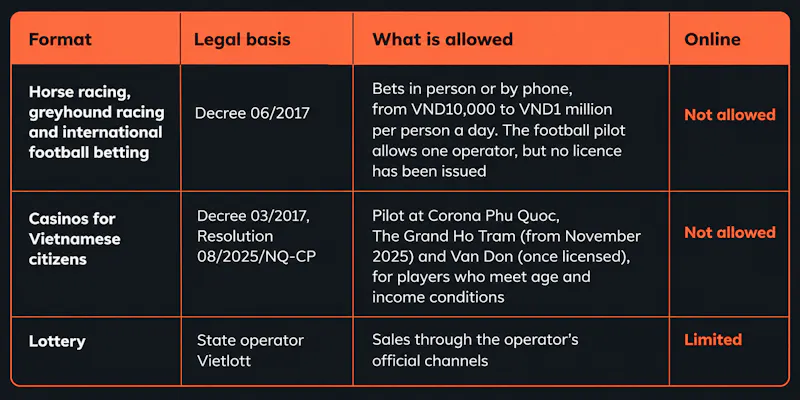
In practice, Vietnamese bettors have no legal channel for placing and paying for a sports bet online, so demand flows to offshore sites that collect deposits through local bank accounts.
How illegal betting money moves in Vietnam
Online gambling in Vietnam runs on local bank accounts. Recent police cases follow the same pattern: an offshore platform, often linked to Cambodia, gives a master account to a local organiser. The organiser splits it into agent accounts and sub-accounts and hands them out through messaging apps. Players deposit into mule accounts controlled by the network, and the deposits are credited as betting points.
In the first 20 days of the 2026 World Cup alone, the Ministry of Public Security broke up 73 gambling operations. For banks and payment providers, the typical red flag is a retail account receiving many small transfers from unrelated payers, with turnover well above the customer's declared profile. Funds rarely stay in these accounts for long.
Payment rails in Vietnam: NAPAS 247 and QR transfers
Vietnamese consumers pay mostly by bank transfer. NAPAS 247, the 24/7 instant interbank system run by NAPAS, Vietnam's national payment corporation, processed 8.9 billion transfers in 2024, up 33.8% year on year. VietQR, the national QR standard that runs on top of it, handles about 15 million transfers a day and is accepted by around 85% of merchants.
Any personal bank account can receive VietQR payments. This lowers the barrier for small merchants but blurs the line between a shop and a collection account run by a betting network: in transaction data, both look like an individual receiving frequent small transfers from different payers.
Biometric checks and State Bank of Vietnam regulations
The State Bank of Vietnam (SBV) uses account identity as its main tool against rented accounts. Since 1 July 2024, under SBV Decision 2345, individuals must confirm any online transfer above VND10 million, or any transfers totaling above VND20 million in one day, with biometrics. The biometric data is checked against the national ID database, and opening an electronic account requires a chip-based ID card.
The SBV said the rule was meant to filter out bought and rented accounts, the mule accounts fraudsters use to hide their identity. The 2026 cases show its limits. Networks still spread deposits across many accounts opened in other people's names, so monitoring has to compare activity across linked accounts.
AML compliance: Vietnam on the FATF grey list
Vietnam has been on the FATF grey list, formally the list of jurisdictions under increased monitoring, since 2023. FATF kept it on the list at its plenary on 19 June 2026. Its action plan asks Vietnam to improve its understanding of money laundering risk, supervise financial institutions and DNFBPs (casinos included) on a risk basis, regulate virtual assets and their service providers, and close gaps in customer due diligence and suspicious transaction reporting.
For payment providers, this has two effects. Foreign banks and partners apply enhanced due diligence to Vietnamese flows while the listing stands. Inside the country, investigators rebuild gambling schemes from bank records, so a bank or PSP that processed the money is likely to be drawn into the investigation.
The next review is due at the October 2026 plenary.
Sports betting in Vietnam: what the draft decree would change
The Ministry of Finance has been working on a decree to replace Decree 06/2017 since 2025, and in September 2026 it was still a draft. The ministry has also raised the idea of a separate law on casinos and betting.
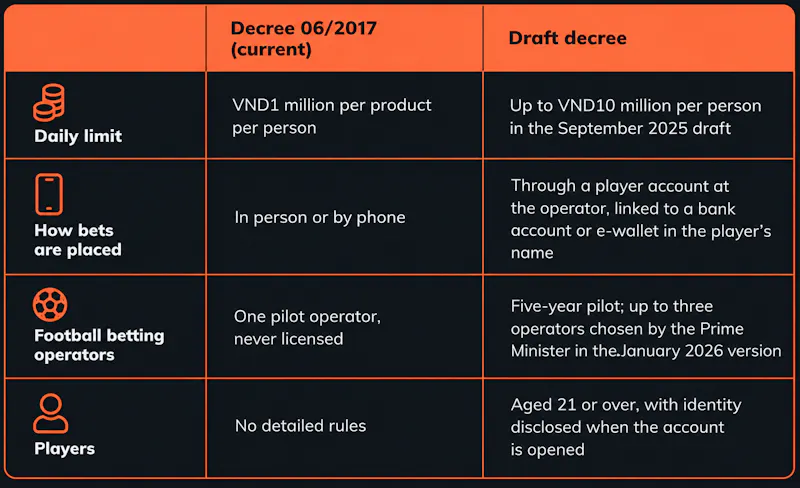
Reports on the daily limit differ. The September 2025 draft raised it to VND10 million, while a January 2026 report said the limit would stay as it is. A separate draft decree on administrative penalties would set maximum fines in the betting and prize-game sector at VND200 million for organisations and VND100 million for individuals.
The payment design matters most for PSPs. Under the draft, legal betting would for the first time have a defined payment flow tied to verified bank accounts and e-wallets, which would create demand for KYC-linked payment acceptance and for monitoring of daily stake limits. The pilot would still be small, though: one to three operators and international football only. Online casinos and every other form of online betting would stay illegal.
What payment providers should watch
Domestic accounts with gambling patterns are the main exposure. Payment providers working in Vietnam should look for accounts that receive many small transfers from unrelated senders, especially during major football tournaments, when betting volumes and police activity both peak.
Cross-border links need attention too. Most of the networks uncovered in 2026 were tied to platforms or account holders in Cambodia, so transfers and account relationships connected to Cambodian entities deserve closer review.
The reform timeline is worth tracking. If the new betting decree is adopted, licensed operators will need payment partners that can tie each player account to a verified bank account or e-wallet and enforce the daily stake limit. Until then, every online betting flow in Vietnam remains illegal.