
Picture a player who just won $200 and taps - withdraw. For the next few hours, they’re grading you on how long the money takes and whether anyone tells them what’s going on. That grade follows them to the next deposit. Many players search for a fast withdrawal casino before they pick one, so they do compare.
Now the money goes the other way, and we’ll look at how slow iGaming payouts affect your revenue.
Why withdrawal is where a player forms an opinion
Deposits are the simple part. The player is motivated, the cashier is built for speed, and every operator they might compare you with takes money in seconds.
A withdrawal is the first time the player asks you for something, and it shows what your processes are really like. Cash out smoothly once and the player has a reason to run another deposit-and-withdrawal cycle. Wait four days for the first payout and a competitor’s cashier is one tab away.
For retention and payments teams, that puts payout performance in the retention report, right next to churn and bonus cost. Player retention in iGaming depends partly on how fast you pay and how clearly you say so.
What fast means in India, Brazil and Kenya
“Fast” depends on where the player lives. The yardstick is the rail they already use every day, so someone typing fast payouts online casino into a search bar probably has their own banking app in mind.
- In India, UPI and IMPS run 24/7 and credit an account in seconds. A player who topped up through UPI in ten seconds will look at a two-day bank transfer and see a different product.
- In Brazil, PIX does the same thing, any hour of any day, from a phone.
- In Kenya and other M-Pesa markets, money reaches a mobile wallet in seconds, and the player spends it or cashes out at an agent.
Cards and wires are the slow lane, so allow one to three banking days. If the deposit went in over an instant local rail and the payout leaves over a slow one, the player feels the mismatch right after a win. In these markets a same day payout casino is the baseline, and “same day” already sounds late to someone whose bank app settles in seconds.
Part of the delay is also yours. A payout on an instant rail that sits eight hours in manual approval still takes eight hours. Split the wait into what you control (review queues, risk rules) and what the rail controls. Fix your half first.
Pending withdrawal at a casino: how silence becomes churn
“Pending” covers three different waits: your own review, the payment provider’s processing, and the bank. The player sees one grey label and no time estimate.
So they write to support and get a template answer. Some cancel the withdrawal and play the balance back, if your cashier lets them. Others give up and move to a competitor, and some tell the story on a forum.
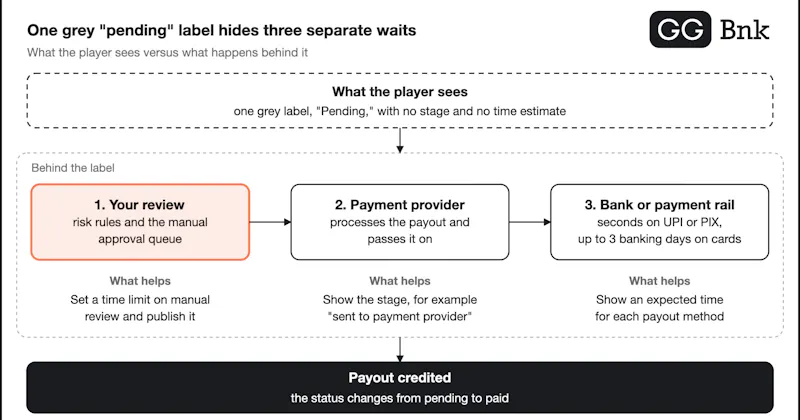
Cheap solutions:
- Show the stage (“in review,” “sent to payment provider,” “sent to bank”) and an expected time for each.
- Set a time limit on manual review and publish it.
- Message the player at every status change, in the channel they signed up with.
- Track two numbers: the share of withdrawals still pending after one hour and after 24 hours, and support tickets per 1,000 withdrawals.
How GG/bnk handles payouts
GG/bnk pays out instantly, without bank delays, and charges the operator 0% on payouts across all countries and methods. One integration covers 15+ countries and 20+ local payment methods, and GG|bnk also supports fiat and crypto exchange. Players can withdraw to GG|bnk Wallet, where a 2% cashback on the withdrawal waits for their next deposit.
iGaming payout fees: what each withdrawal costs you
iGaming payout processing is priced differently from deposit processing, and it's easy to miss. Deposits usually carry one percentage fee. A payout can stack a percentage, a fixed fee per transaction, and a currency conversion spread, and failed or returned ones add support time.
Here’s an illustrative example from GG|bnk. Take an operator with $10M in monthly deposits and a 60% hold rate, which is typical for emerging markets. Withdrawals come to $4M. At a 2% payout fee, that’s $80,000 a month, or $960,000 a year. Standard PSPs charge anywhere from 1.5% to 5% and up for payouts, and at 5% the same $4M costs $200,000 a month. Your real figure depends on your own tariffs.
Ways to reduce costs:
- Price payouts per method and country instead of accepting one blended rate. Compare card, bank and local-wallet routes separately.
- Send local payouts over local rails where they exist.
- Count failed and returned payouts as a cost line. Each one costs you twice, in support time when it fails and in fees when it’s resent.
- Offer a wallet as the payout destination. A balance the player leaves there for the next session comes back to your cashier without another trip through the bank.
- Move to a model with no payout fee.
One more case: players who deposit in crypto and expect a crypto cashout in return. A provider that converts between fiat and crypto can pay them out in the form they hold.
Calculate what payouts cost you and compare it with the GG|bnk model
Pull last month’s withdrawals and group them by method and country. Apply the real fee to each group, then add fixed fees, conversion costs and failed payouts. That total is the number to compare with a 0% payout model. The GG|Bnk calculator runs the same arithmetic on your inputs, and the result depends on your current tariffs.
FAQ
What counts as a fast withdrawal casino?
One that pays as fast as the player’s own payment method can receive money, with no extra waiting on the operator’s side. For UPI, IMPS, PIX and M-Pesa that means seconds. For cards and bank wires, the bank sets the pace, and it can take up to three banking days. Your own review time counts toward the total.
What does a pending withdrawal casino status mean?
The request hasn’t reached the player’s account yet. It’s sitting in one of three places: your internal review, the payment provider or the bank. Showing which one, with an estimate, clears up most of the confusion.
What is the difference between an instant withdrawal casino and a same-day one?
Instant means the money arrives within seconds or minutes of approval. Same day means within the calendar day. Instant needs a fast rail and a short approval queue.
What is an instant withdrawal payment provider?
A provider that sends payouts over rails that settle in seconds. When you compare providers, ask which countries and methods they cover, what they charge per payout and how they report statuses.
Do fast payouts make players withdraw everything and leave?
Withdrawals get more frequent, and each one is a chance to bring the player back. A wallet balance and a cashback on the next deposit give a reason to return. Track the 30-day return rate after a payout, split by payout speed.
How do I lower iGaming payout fees?
List fees per method and country, route local payouts over local rails, count failed payouts as a cost, and compare the total with a model that has a 0% payout fee.