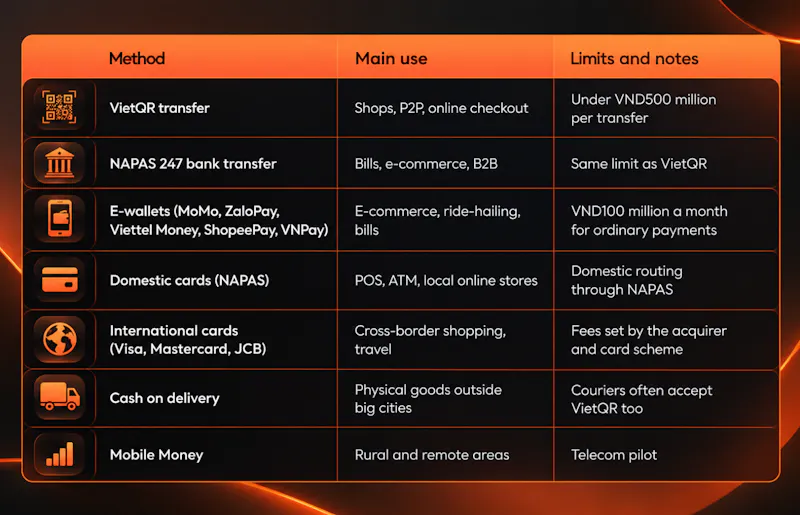
The most popular payment methods in Vietnam are instant bank transfers, and most of them start with a scan of a VietQR code in a banking app. By October 2025, close to 90 million mobile banking accounts were using VietQR. E-wallets such as MoMo, ZaloPay and Viettel Money come second, with about 30 million active wallets, while cards and cash on delivery cover international purchases and part of eCommerce. Below is how to pay in Vietnam with each method, what the State Bank of Vietnam (SBV) allows, and which methods an online merchant should offer.
How to pay in Vietnam: payment methods at a glance
What is VietQR and how does it work?
VietQR is the national QR code format for bank transfers, launched by NAPAS and partner banks in 2021 and supported by more than 50 banks. A VietQR code follows the EMVCo standard and holds the recipient bank’s BIN, the account or card number, and a service code for a NAPAS 247 transfer. The payer scans it, checks the account holder’s name in the app, confirms, and the money arrives within seconds at any hour. A printed code is all a small shop needs to start taking payments.
Static and dynamic VietQR codes
A static code holds only the account details, so the payer types the amount. A dynamic code also carries the amount and an order reference and is generated for each purchase. Online merchants need dynamic codes, because each VietQR payment then arrives with the exact amount and an order ID that the system matches on its own. With a static code at checkout, customers type the amount and reference themselves, and someone has to match payments by hand.
Vietnam QR payment statistics: SBV and NAPAS data for 2025–2026
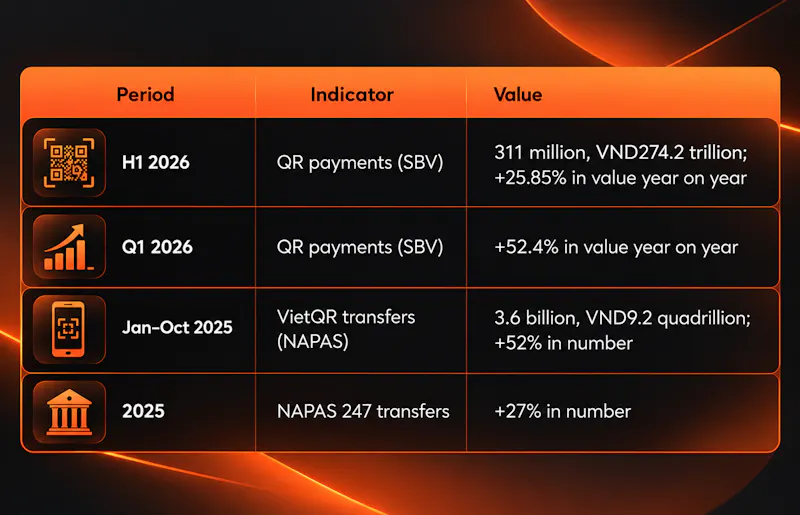
The two sources count different things: the SBV’s QR line covers purchases through merchant QR codes, while most VietQR traffic is person-to-account transfers that NAPAS records as interbank transfers.
VietQRPay, VietQRGlobal and VietQRMe
The SBV wants retail to move from transfer QR to payment QR. VietQRPay, launched by NAPAS in 2025, ties the code to a registered business account and adds merchant and order data, which keeps shop revenue apart from personal transfers. VietQRGlobal handles cross-border payments: visitors from Thailand, Laos, Cambodia, China and South Korea scan Vietnamese codes with their home apps, and the merchant receives dong. VietQRMe is a customer-presented code used on buses, the metro and in parking lots.
Bank transfers in Vietnam: how instant interbank payments work
NAPAS 247 is the instant interbank system behind VietQR and most online bank payments. It runs around the clock and settles transfers between almost any two banks in seconds. At the end of 2025, Vietnam had more than 232 million personal payment accounts, and over 87% of people aged 15 and over had a bank account.
At checkout, the customer starts the transfer in their own banking app, so the merchant never handles card numbers or logins. The app shows the name on the receiving account before the payer confirms. A completed transfer is final: there is no chargeback, and a refund is a new transfer from the merchant.
A single NAPAS 247 transfer must be under VND500 million. Larger payments go through the SBV’s interbank system, and banks are told not to split them. Online transfers above VND10 million need a face scan in the banking app. More on that rule is in our iGaming payments in Vietnam guide.
The same rails carry payouts, so a marketplace or insurer can pay any user’s bank account in seconds, weekends included. To match incoming payments to orders, payment providers offer dynamic VietQR codes and virtual accounts, with a separate account number for each customer or order.
E-wallets in Vietnam: MoMo, ZaloPay, Viettel Money and others
Vietnam had 49 licensed e-wallet (digital wallet) providers at the end of September 2025, and about 30.35 million of 49.57 million activated wallets were active.
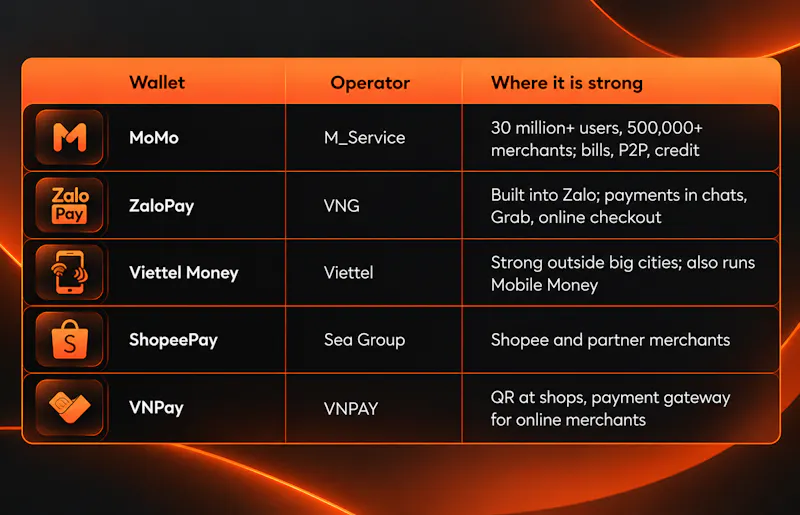
Under Decree 52/2024 and Circulars 40/2024 and 41/2025, a personal wallet must be linked to the owner’s own VND account or debit card, and the owner passes a biometric check when opening it. Ordinary wallet transactions are capped at VND100 million a month per provider, and payments for essential services such as utilities, tuition and insurance at VND300 million. Most wallets also scan VietQR codes, so customers can pay a VietQR invoice from a wallet balance.
NAPAS cards, cash on delivery and Mobile Money in Vietnam
More than 164 million bank cards were in circulation at the end of 2025. Most are NAPAS cards, the domestic debit cards used at ATMs, POS terminals and local online stores, and they now work with Apple Pay and Android tap-to-pay. Visa, Mastercard and JCB cover cross-border purchases and travel.
Cash on delivery is still common outside Hanoi and Ho Chi Minh City, though couriers increasingly take a VietQR scan at the door. Mobile Money, run by Viettel, VNPT and MobiFone under a government pilot, lets people in rural areas pay from a telecom account without a bank account.
Choosing a Vietnam payment gateway: which methods to offer
A checkout for Vietnam starts with VietQR and bank transfers, then adds MoMo and one or two other wallets, then cards for cross-border buyers.
Collecting VND payments requires an SBV-licensed bank or payment intermediary, so foreign PSPs and merchants usually connect through a local online payment gateway or licensed partner. One integration then covers bank transfers, dynamic VietQR, wallets and local settlement. Plan for VietQRPay merchant codes now, since the SBV is moving retail to payment QR.
Wallet caps and identity checks shape the payment flow. When a payment is larger than what is left on a customer’s wallet limit, offer a bank transfer instead. Refunds and payouts are outgoing payments the merchant starts, and payouts go only to an account in the user’s own name. When comparing fees, count the cost of reconciliation and refunds as well.
Bank partners look more closely at merchants in regulated sectors. Online betting is illegal in Vietnam; the legal position and compliance risks are in our guide to iGaming payments in Vietnam.
FAQ: payment methods in Vietnam
What is the most popular payment method in Vietnam?
Instant bank transfers through NAPAS 247, usually started with a VietQR scan. E-wallets come second.
What is VietQR?
Vietnam’s national QR code standard for bank transfers, run by NAPAS. Any banking app in the network can scan any bank’s code.
What is the difference between VietQR and VietQRPay?
VietQR sends money to a bank account, usually a personal one. VietQRPay is a merchant code tied to a business account, and it carries order data.
What is the e-wallet limit in Vietnam?
VND100 million a month per provider for ordinary transactions and VND300 million for essential services.
What is the bank transfer limit in Vietnam?
Under VND500 million per instant transfer. Banks also set daily limits, and transfers above VND10 million need a face scan.
MoMo vs ZaloPay: what is the difference?
The MoMo wallet is a standalone super app for payments, bills and financial services. The ZaloPay app sits inside the Zalo messenger and is used most for payments in chats and partner apps.
How do tourists pay in Vietnam?
Visitors from Thailand, Laos, Cambodia, China and South Korea can pay through VietQRGlobal with their home apps. Others usually use an international card or cash.
Which payment methods should an online store in Vietnam offer?
Dynamic VietQR or bank transfer first, then MoMo and another wallet or two, then cards. Cash on delivery still matters for physical goods.