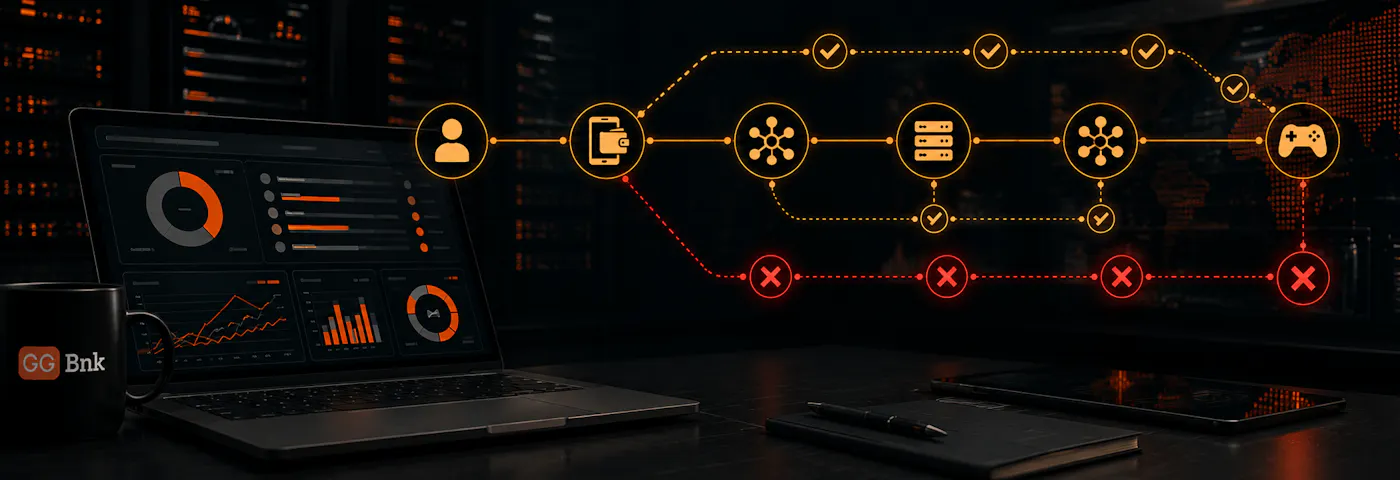
Bangladesh has become one of the most active betting markets in South Asia. Mobile wallets dominate everyday payments, digital transactions continue to grow, and players are comfortable moving money online through services such as bKash and Nagad.
Yet payment declines remain a regular operational issue for betting operators.
A player opens the cashier, selects a payment method, confirms a deposit, and receives an error message. Sometimes it's a one-off event. Sometimes it's the first sign of a larger payment problem.
The difficulty is that a declined transaction rarely explains what actually happened.
The same error message can be caused by a timeout, a routing issue, a risk-control trigger, a wallet restriction, or a provider-side review. From the player's perspective, every scenario looks identical. For payment teams, the difference matters.
Understanding where and why transactions fail is one of the most important parts of managing gambling payment processing in Bangladesh.
A Decline Is a Result, Not a Diagnosis
Players see only the final outcome.
Approved.
Declined.
Everything that happens between those two statuses is hidden.
A gambling transaction can fail because of:
- wallet-level restrictions
- routing interruptions
- provider-side controls
- transaction monitoring
- authentication failures
- compliance-related reviews
Two failed deposits can display the same message while originating from completely different parts of the payment chain.
This is why decline analysis starts with identifying the source of the failure rather than focusing on the decline itself.
Deposit Declined vs Payment Pending
One of the most common mistakes is treating declined and pending transactions as the same issue.
They are not.
A declined transaction usually means the payment did not complete the full processing cycle.
A pending transaction means the final status has not yet been confirmed.
From the player's perspective, both situations may look identical.
For operators, they require completely different responses.
Pending transactions often appear during:
- traffic spikes
- processing delays
- temporary routing congestion
- settlement interruptions
A genuine decline usually points to a problem elsewhere in the transaction flow.
Understanding that distinction helps payment teams avoid chasing the wrong problem.
Mobile Wallets Are Only Part of the Story
Bangladesh remains heavily dependent on mobile financial services.
As discussed in iGaming Payment Methods in Bangladesh: What Actually Works, most online gambling deposits rely on a small number of familiar payment methods.
The most common options include:
- bKash
- Nagad
- Rocket
- QR-based payment flows
These wallets are essential because players already trust them.
At the same time, wallet availability alone does not explain transaction outcomes.
A player may successfully authenticate a payment and still encounter a failed deposit because the issue occurred later in the processing chain.

The Most Common Sources of Transaction Failures
Payment teams reviewing declines usually see the same categories appear repeatedly.
Transaction Timeouts
The payment process takes longer than the allowed processing window.
The player completes the payment attempt, but the transaction never reaches final confirmation.
Authentication Failures
The transaction cannot be completed because the authentication step was interrupted or not finished correctly.
Routing Failures
The selected route becomes unavailable or unable to complete the transaction.
The wallet remains operational, but the payment still fails.
Risk-Control Reviews
Automated monitoring systems may flag activity that requires additional assessment.
The player receives a decline even though no obvious issue is visible from the front end.
Duplicate Transaction Attempts
Players frequently retry deposits after delays.
Multiple requests submitted within a short period can trigger additional controls and create avoidable failures.
Why Players Leave After Failed Deposits
Payment teams focus on approval rates.
Players focus on outcomes.
A successful deposit strengthens confidence.
A failed deposit creates uncertainty.
Some users retry immediately.
Others leave.
The longer the issue continues, the more likely a player is to abandon the transaction entirely.
This is why even short periods of payment instability can have a measurable impact on conversion and retention.
Declines are not only a payment problem. They are also a customer experience problem.
Why Support Teams Often Misdiagnose Payment Issues
Many payment problems first appear in customer support queues.
Support teams see complaints.
Payment teams see transaction data.
Those perspectives are not always the same.
A player reporting a failed deposit may be experiencing:
- a timeout
- a routing issue
- a pending transaction
- a duplicate request
- a provider-side review
Without visibility into transaction data, different issues can look identical.
This is one reason payment investigations rarely begin with the support ticket itself.
The transaction history usually provides more useful information than the error message.
What Payment Teams Check Before Changing PSPs
Replacing a provider is rarely the first step.
The first objective is understanding where the failures are concentrated.
Payment teams typically review:
- wallet-level approval rates
- route-by-route performance
- transaction timing
- decline patterns
- payout activity
- fraud indicators
The question is simple:
Is the problem linked to one payment method, one route, one provider, or one category of transaction?
Finding that answer usually determines what happens next.
Early Warning Signs of Approval-Rate Deterioration
Large approval-rate drops rarely appear without warning.
Several indicators tend to surface first:
- rising wallet-specific declines
- longer payout review times
- weaker performance during peak betting periods
- increasing dependence on a single route
- widening gaps between attempted and completed deposits
These signals often appear before revenue impact becomes visible.
Operators that monitor them closely usually have more time to respond.
bKash and Nagad Transactions Are Not Immune to Declines
bKash and Nagad remain the most important payment methods in Bangladesh. Their role in gambling payments is covered in detail here.
Strong adoption does not eliminate transaction failures.
Operators processing large volumes through these wallets still encounter:
- transaction filtering
- routing interruptions
- approval-rate fluctuations
- account-level restrictions
- payout-related reviews
The issue is rarely user demand.
More often, the challenge sits somewhere within the payment infrastructure supporting those transactions.
FAQ
Why do gambling transactions get declined in Bangladesh?
A declined transaction can be caused by routing interruptions, timeout events, transaction monitoring, authentication failures, provider-side reviews, or wallet-related restrictions. The same error message may have different underlying causes.
What is the difference between a declined and a pending transaction?
A declined transaction has failed and cannot be completed in its current state. A pending transaction is still being processed and may eventually be approved or reversed depending on the outcome of the payment flow.
Do bKash and Nagad block gambling transactions?
Not necessarily. Many failed transactions associated with bKash or Nagad originate elsewhere in the payment chain, including routing infrastructure, provider controls, or transaction monitoring systems.
Why do deposits fail during major sporting events?
Peak betting periods often generate higher transaction volumes. Increased traffic can lead to processing delays, timeout events, and temporary routing congestion that affect approval rates.
Why do players stop depositing after failed transactions?
Many players will retry once after a failed deposit. Repeated failures reduce confidence in the platform and increase the likelihood of abandonment, which directly impacts conversion and retention.
What should operators investigate first when approval rates start falling?
Most payment teams begin by identifying where declines are concentrated. Wallet-level performance, routing data, transaction timing, and decline patterns usually provide the clearest starting point for troubleshooting.
Are all transaction declines caused by fraud controls?
No. Fraud controls are only one possible cause. Routing failures, timeout events, authentication problems, and provider-side reviews can all produce declined transactions.
Conclusion
A declined transaction tells operators what happened.
It does not explain why it happened.
The same decline message can be linked to routing failures, timeout events, authentication issues, risk controls, transaction monitoring, or wallet-related restrictions.
Finding the source of the failure is what allows payment teams to fix it.
In Bangladesh, transaction diagnostics matter just as much as payment methods themselves. The operators that understand how declines occur are usually the ones that recover performance fastest when problems emerge.